China Top 10 Anti Slip Bar Grating Manufacturers
China’s Anti Slip Bar Grating industry is expanding with demand from factories, platforms, stairways, drainage channels, and offshore facilities. Buyers now examine more than price. They compare serrated bearing bars, load capacity, opening size, corrosion protection, welding quality, and delivery consistency.
The U.S. Bureau of Labor Statistics reported 865 fatal workplace injuries involving falls, slips, and trips in 2022. In Great Britain, the Health and Safety Executive recorded slips, trips, and falls on the same level as 31% of specified non-fatal workplace injuries in 2023/24. These figures show why surface design deserves careful attention. Anti Slip Bar Grating can improve traction, especially where water, mud, oil, or metal dust collects. It cannot correct poor drainage or unsafe maintenance.
Dr. David Michaels, former Assistant Secretary of Labor for Occupational Safety and Health, stated, “Every worker has the right to return home safe and healthy at the end of each workday.” That principle gives this manufacturer review a practical purpose. The following selection examines China’s leading suppliers through product experience, manufacturing capability, testing practices, certifications, export performance, and customer support. It also considers details visible on a real project, such as clean serrations under a boot, even weld spacing, and undamaged galvanized edges.
A ranking is never permanent. Factory capacity changes. Quality can vary between batches. Therefore, readers should verify drawings, samples, material grades, and current inspection records before purchasing. These ten manufacturers offer useful starting points, not automatic guarantees.
Anti-Slip Bar Grating Basics: Serrated Bars, Materials, and 3–6 mm Sizes
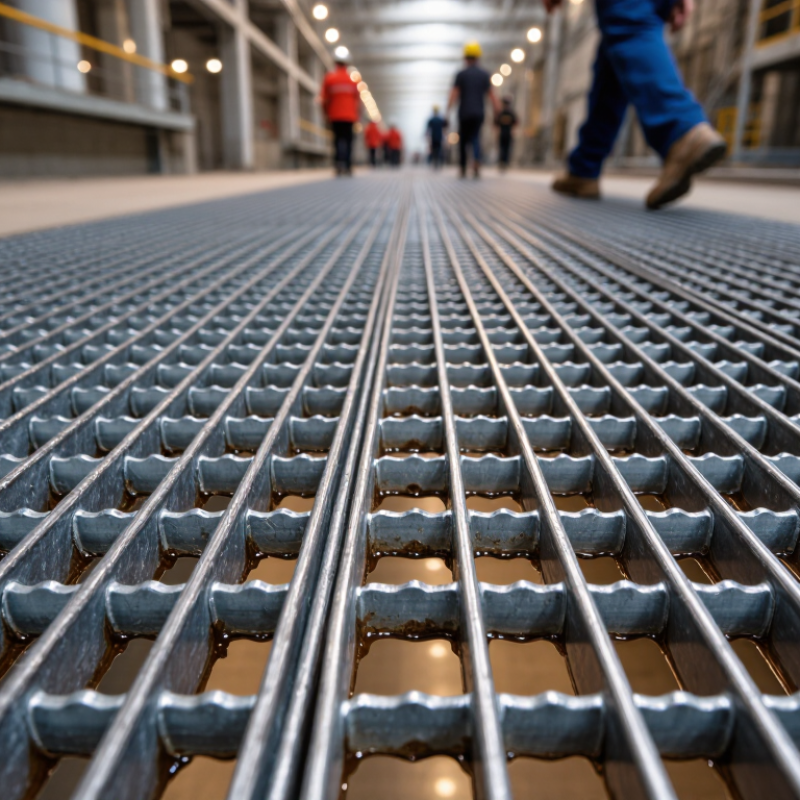
Anti-slip bar grating relies on serrated bearing bars to create small, repeated contact points. These teeth improve traction when footwear, oil, rain, or fine dust reduces friction. Smooth bars may appear cleaner, but they can become hazardous on exposed platforms.
Common bearing bar thicknesses range from 3 to 6 mm. However, thickness alone does not determine capacity. Bar depth, span, spacing, support direction, and live load also matter. A 3 mm bar may suit a short walkway, while a 6 mm bar may be preferable for heavier industrial traffic. The final selection should follow load calculations and ISO 14122-2 access-safety guidance.
Carbon steel offers strength and cost efficiency. Hot-dip galvanized steel adds corrosion protection for outdoor service. Stainless steel suits wet, hygienic, or chemically aggressive areas, although its price is higher. Aluminum reduces weight, but its lower stiffness requires careful span design. The World Steel Association reported about 1,888 million tonnes of crude steel production in 2023, supporting steel’s broad availability for fabricated grating. Still, availability is not proof of quality. In practical inspections, weld consistency, serration sharpness, zinc coverage, and dimensional tolerance deserve equal attention. A drawing can still mislead. Manufacturers should provide material certificates, coating records, and test data rather than relying on appearance.
Evaluation Criteria: Load Capacity, Slip Resistance, Coating, and Export Data
China Top 10 Anti Slip Bar Grating Manufacturers
A credible ranking should begin with load capacity, not catalog photos. ISO 14122-2 provides a recognized framework for industrial platforms, walkways, and stairs. Buyers should request span tables, steel grade, bearing-bar size, and third-party test records. Capacity changes sharply when supports are spaced farther apart. One attractive panel may still deflect under a loaded trolley.
Slip resistance needs measurable evidence. ISO 20344 and ASTM F2913 offer useful testing principles, although neither replaces a project-specific assessment. Serrated bearing bars usually improve drainage and traction in oily or rainy areas. However, sharp profiles can increase cleaning difficulty and footwear wear. I would inspect wet samples, not trust the phrase “anti-slip” alone. Small details matter.
Coating performance also deserves laboratory proof. ISO 12944 helps compare corrosion protection systems by environment and durability category. Galvanizing thickness, surface preparation, and repair quality should appear in inspection documents. Export data can support supplier screening, but it cannot prove manufacturing quality. UN Comtrade and ITC Trade Map often place grating within broader HS 7308.90 categories, so shipment figures may include other fabricated structures. That limitation is easy to overlook. A stronger top-ten evaluation combines export consistency, documented testing, coating records, and realistic load calculations. Some rankings will remain imperfect. That is precisely why factory audits and sample checks still matter.
Technical Standards: ASTM A123, ISO 14122-2, and DIN 51130 R10–R13
China Top 10 Anti Slip Bar Grating Manufacturers
When evaluating anti-slip bar grating manufacturers, technical standards deserve close attention. ASTM A123 covers hot-dip galvanized coatings on fabricated iron and steel products. It helps buyers verify coating coverage, thickness, and durability against outdoor corrosion. However, ASTM A123 does not define walking-surface slip performance.
ISO 14122-2 addresses permanent platforms and walkways used with machinery. It covers practical requirements such as clear width, access, drainage, and safe installation. A responsible manufacturer should connect these requirements with bar spacing, bearing bars, and support conditions. Small details matter. Poor drainage can leave oil or rainwater trapped on the surface.
DIN 51130 classifies slip resistance through ramp testing with safety footwear. Ratings from R10 to R13 indicate increasing resistance under defined test conditions. R10 may suit relatively low-risk areas, while R13 is intended for more demanding environments. The rating depends on test conditions, footwear, contaminants, and surface structure. It should not be treated as a universal guarantee.
Field inspections often reveal a gap between laboratory results and installed performance. Weld quality, edge finishing, panel deflection, and maintenance can change actual underfoot grip. Request test reports, galvanizing records, material certificates, and installation drawings. Check whether the documents match the delivered panels. A certificate alone is not enough. Manufacturers should also explain limitations clearly, even when the answer is inconvenient.
This chart shows the minimum slip-angle thresholds for DIN 51130 anti-slip classes R10–R13. Higher R classes indicate greater slip resistance. ASTM A123 is used for hot-dip galvanized coating requirements, while ISO 14122-2 addresses the safety design of fixed platforms and walkways; these standards are referenced as technical selection criteria rather than plotted as comparable numerical values.
Purchasing Metrics: Span Loads, Open Area, Corrosion Life, and MOQ
China Top 10 Anti Slip Bar Grating Manufacturers: Purchasing Metrics
Span load should be checked before price. NAAMM MBG 531-23 evaluates bar grating by clear span, bearing bars, load, and deflection. A practical request should state the span, uniform load, point load, and allowable deflection. Many industrial platforms use L/240 as a serviceability reference, but this is not universal. Do not accept “heavy duty” without a load table. A 1,000-kilogram pallet creates a very different risk from foot traffic.
Open area affects drainage, daylight, airflow, and cleaning. Common bar grating designs provide roughly 60% to 80% open area, depending on pitch and bar width. Confirm the net opening, not only the nominal panel size. A 30-millimeter opening may still trap debris in dusty production areas. That detail is easy to overlook. ASTM E985 and NAAMM guidance can support dimensional review, while project drawings should control final acceptance.
Corrosion life needs an exposure classification. ISO 9223 separates atmospheric environments from low to extreme corrosivity. ISO 12944-1 defines “high” coating durability as 15 to 25 years, but this is a durability range, not a guaranteed service life. Ask for coating thickness, pretreatment, salt-spray evidence, and repair procedures. MOQ also deserves measurement. Request sample quantity, repeat-order quantity, cutting fees, and lead time separately. Industry procurement surveys often show that lower unit prices can hide inventory and carrying costs. That is where the calculation becomes less comfortable.